 Debank
 history separates asset transfers from network gas fees
Debank displays wallet transaction history with asset transfers and gas fees as separate amounts. The transfer describes assets sent or received; the gas fee pays for network execution. For an ordinary direct transfer of the native gas token, the sender's debit includes both amounts, while the recipient receives the transfer amount. Contract-token movements need a separate comparison because the transferred token and the gas token may differ. The sender identifies the ordinary gas payer. Execution status reports success or failure; recorded asset movements show what moved.
Last updatedTransfers and gas explain different balance changes
A transaction history combines asset movements with execution costs, allowing the same event to explain both a recipient's credit and a sender's larger debit. Send and Receive describe the direction of assets relative to the address being viewed. The Gas Fee line describes a separate cost associated with the transaction. Adding a fee to the displayed transfer would therefore overstate what went to the recipient.
The units determine whether addition makes sense. A native-token transfer and a gas charge denominated in that same native token can contribute to one balance decrease. A contract token and a different gas token belong to separate balances. Their quantities cannot form a meaningful combined token amount, even when a portfolio presents both with dollar equivalents.
Contract calls and token recipients can use different addresses
A contract-token transfer can reach its recipient through a call to the token contract, so the transaction destination can differ from the asset destination.
The contract executes the transfer
For a direct ERC-20 transfer, the transaction calls the token contract. Its transfer operation names the recipient and quantity. The outer transaction's destination identifies the contract executing that operation; it does not automatically identify the address receiving the tokens. This explains why a contract address can appear beside an otherwise ordinary wallet transfer.
Native value has its own meaning
The transaction's native value and its contract-token amount describe different assets. A native value of zero can accompany a nonzero token transfer because the movement happens inside the contract. Gas remains separate from both quantities. When interpreting history data, pair each movement with its token identifier and recipient instead of treating every value field as interchangeable.
The initiating account identifies the ordinary gas payer
Fee attribution starts with the account that initiated the blockchain transaction, which can differ from the address whose asset activity appears in a history view.
For an ordinary Ethereum transaction from a key-controlled account, the transaction sender pays the network gas fee. That payment comes from its native gas balance.
Receiving an ordinary direct transfer does not require the receiving address to submit a transaction. The recipient therefore owes no network gas merely for that receipt. A fee associated with the incoming transaction belongs to its payer, even if another interface displays it alongside the received assets.
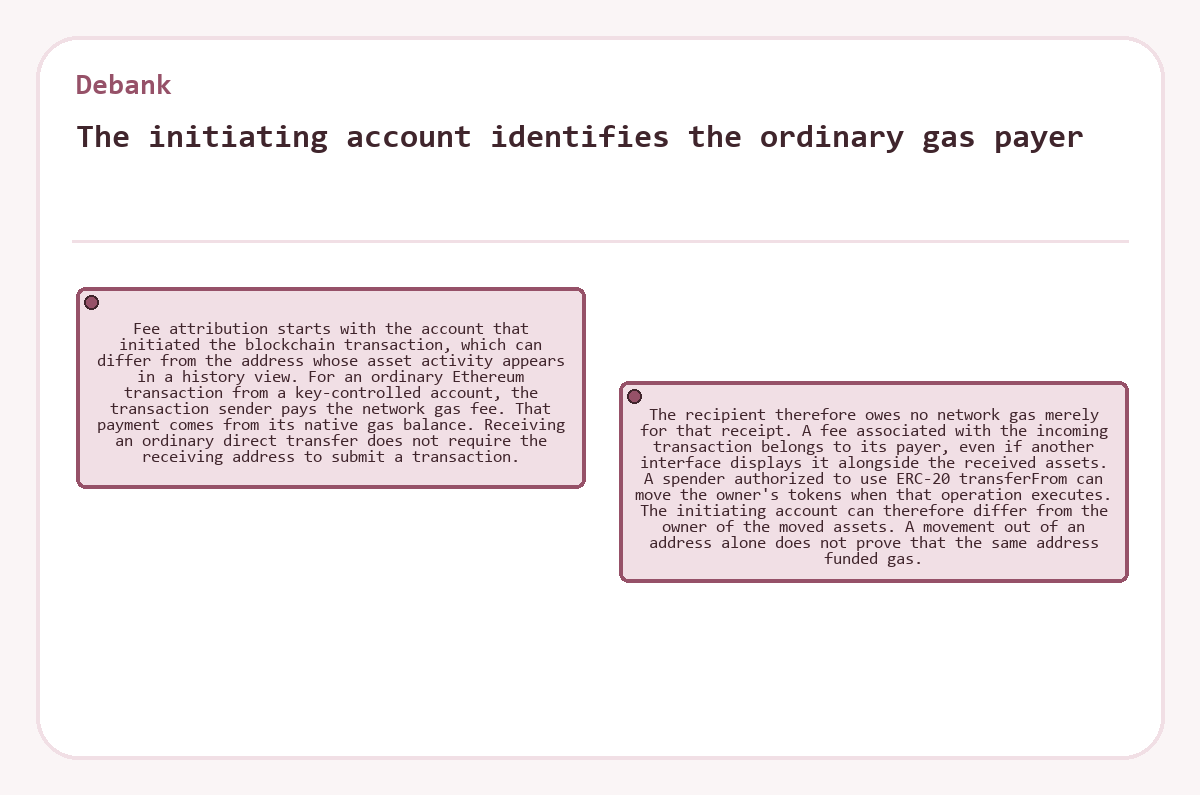
A spender authorized to use ERC-20 transferFrom can move the owner's tokens when that operation executes. The initiating account can therefore differ from the owner of the moved assets. A movement out of an address alone does not prove that the same address funded gas.
A native-token transfer explains the larger sender debit
Debank's separate transfer and fee amounts resolve a common question: whether a larger sender debit means the recipient received the gas payment too.
Consider a hypothetical ordinary direct transfer on a supported chain that charges gas in its native token. The recorded transfer is 0.68475 native-token units, and the recorded gas fee is 0.00215 units of that same token. Assume successful execution, a sender-funded fee, and no other balance changes.
The sender's decrease is 0.68475 + 0.00215 = 0.68690 native-token units. The recipient receives 0.68475 units. The remaining 0.00215 units pay for execution, so adding them to the recipient's credit would misread the record.
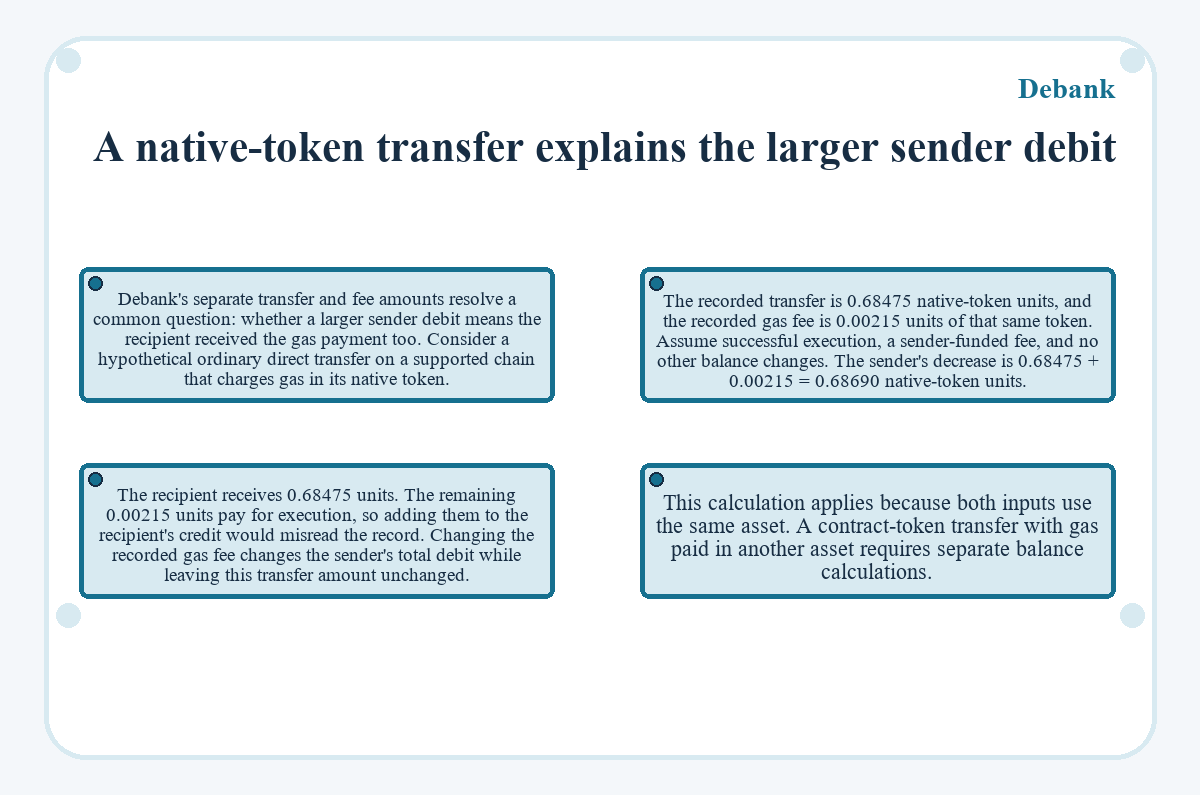
Changing the recorded gas fee changes the sender's total debit while leaving this transfer amount unchanged. This calculation applies because both inputs use the same asset. A contract-token transfer with gas paid in another asset requires separate balance calculations.
Recorded gas usage explains the execution cost
The network receipt describes the execution that occurred, while the transaction's fee settings describe the limits and prices under which that execution was authorized.
Gas usage and effective price determine the fee
An Ethereum transaction's execution fee equals its gas used multiplied by its effective gas price. Gas used measures computational work. Effective gas price expresses the charge per gas unit. A token quantity, a gas quantity, and a native-token fee therefore have different units and meanings.
The gas limit is a budget
A gas limit caps the computational work that the transaction may consume. It is not the quantity necessarily consumed. Likewise, a maximum price per gas unit is not necessarily the effective price paid. Reading a maximum budget as the settled cost can exaggerate the debit. Use transaction-specific gas usage rather than the receipt's cumulative gas usage for the current and preceding transactions in the block.
Why can gas appear without a completed transfer?
Gas can accompany a successful authorization or an execution failure, because computation and asset delivery are different outcomes that a history entry may describe.
Approvals change spending permission
A conventional ERC-20 approval changes the amount that a spender may transfer from the owner's balance. That authorization can consume gas without delivering tokens to a recipient. Its allowance value is a permission amount, so counting it as an outgoing transfer would overstate the assets that moved.
Reverted execution leaves a fee
An Ethereum transaction that reverts during execution still charges for the gas it consumes. A full transaction revert rolls back that execution's state changes. A fee therefore cannot establish a completed transfer. An explicit revert can leave unused gas; running out of gas at the transaction level exhausts the available allocation.
A transaction rejected before block inclusion incurs no on-chain execution fee. That rejection differs from an included transaction that executes and fails, so an unsuccessful attempt alone does not establish a gas charge.
A contract interaction can contain several asset movements
A smart-contract transaction can produce several token movements under one transaction hash, while its network execution fee belongs to the transaction as a whole.
Debank history can display outgoing and incoming assets within a contract interaction. Those movements describe what changed hands; they are not automatically separate blockchain transactions. Charging the whole network fee against every displayed movement would count the same cost repeatedly. Different hashes on the same chain identify separate transactions, even when an application groups those transactions into one activity.
Assets leaving a wallet for a protocol can become part of a deposit or other position. The wallet movement alone does not establish an equivalent loss in overall portfolio value. History explains the movement and execution cost; the resulting position explains where the assets are represented afterward.
Dollar labels do not change the transferred quantity
A dollar-denominated gas label expresses a valuation of the network charge; it does not represent another payment made alongside the native-token fee.
Asset quantities and their dollar equivalents answer different questions. Quantities describe how many units moved. Dollar values depend on a price input. Comparing valuations requires a consistent pricing basis and time, especially when comparing a historical transaction with a current portfolio balance. A price change can alter the displayed portfolio value without creating another transfer.
The difference between the displayed dollar values of outgoing and incoming assets also does not automatically equal gas. Different assets can have different valuations, and a contract interaction can contain additional charges or movements. The separately identified network fee should remain distinct from an unexplained valuation difference.
Chain filters and older entries define the visible history
Debank's chain and token filters select which activity appears, so a filtered history is a view of matching records rather than every wallet event.
Its history API supports a single-chain request and a combined view across supported chains. Older entries require pagination, and a time boundary selects records earlier than that timestamp. A recent result set therefore should not be treated as a lifetime activity record. A token filter can also exclude authorizations or other interactions unrelated to that selected token.
The chain matters when matching an entry to its blockchain transaction. Keep the transaction hash with its chain context, and preserve the asset unit beside every transfer and fee amount. When a displayed total remains unexplained, the corresponding execution record can distinguish the contract call, asset movements, and network cost without treating the whole difference as money sent to the recipient.
Frequently asked questions about Debank
Does a pending transfer already have its final gas fee?
A pending blockchain transaction does not yet have a recorded execution fee. Its proposed fee settings or a wallet estimate describe a possible cost. An execution receipt establishes the gas actually consumed; the transfer's transaction hash alone does not establish that amount or successful delivery.
Why does a Gas Fee line use a less-than sign?
A less-than sign indicates that the amount falls below the displayed threshold, so it should not be read as an exact zero or added into a precise balance calculation without the underlying transaction fee in its original asset units.
Do I need to sign a transaction to inspect Debank history?
Public transaction entries can be inspected without signing a blockchain transaction. Reading an address's history does not authorize spending from it. A recovery phrase or private key controls access to funds and is unnecessary for examining already published transfers and network fees.
Can a transaction hash prove that an exchange credited my deposit?
A transaction hash identifies a blockchain transaction, not the exchange's internal account credit. Successful delivery to a deposit address and crediting a customer account are separate outcomes. A receiving service may require additional confirmations and support for the deposited asset and network before making the funds available.
How do token decimals affect an amount read from transaction data?
For a contract token with a known decimal setting, divide its raw integer amount by ten raised to that setting. Do not rescale quantities already displayed in token units. Missing token precision prevents a reliable conversion; the gas asset's decimals cannot supply it.
Are exchange withdrawal charges included in the displayed network fee?
The displayed network fee describes blockchain execution rather than a complete bill for a custodial withdrawal. An exchange may charge a withdrawal fee under its own schedule to cover transaction costs. That customer charge and the gas paid by the initiating address are separate accounting amounts and need not be equal.