 Debank
 connects DeFi portfolio tracking with Web3 social tools
Debank tracks token balances and DeFi positions across supported Ethereum-compatible chains using a public wallet address. DeFi is short for decentralized finance, which uses blockchain-based financial applications. Address lookup brings those holdings into a portfolio view, while the broader platform includes Web3 profiles, social messaging, and VIP tools for comparing historical asset changes.
Last updatedIn this guide
Address lookup brings wallet and protocol holdings together
Address lookup identifies a portfolio through its public address or Web3 ID and groups recognized holdings by chain and protocol. That organization helps distinguish tokens held directly at an address from assets represented by supported DeFi positions. The scope follows the chains and integrations that the platform supports. The mobile app also supports tracking address activity.
Wallet connection and address lookup have different purposes. A connected account supports account-specific interactions; a searched address identifies public holdings. Reading that address does not establish ownership of it. A profile name can make an address recognizable, although the complete address remains necessary to distinguish it from another account.
Bundles group multiple addresses for portfolio tracking. Their combined view organizes a collection of holdings without merging ownership of the underlying accounts.
What does a DeFi position add to a wallet balance?
A DeFi position shows supported protocol deposits, borrowing, or rewards that a wallet's token balance alone may not explain.
Direct holdings and protocol deposits
Tokens held directly at an address appear as wallet holdings. Protocol positions describe assets and obligations within an application, including deposits, debts, and rewards. The portfolio model accommodates liquidity pools, lending, staking, locked deposits, and positions involving non-fungible tokens (NFTs), where those integrations are supported. Lending records separate deposits from borrowing; liquidity-pool records identify supplied assets and any reported rewards.
Supplied assets, borrowed assets, and reward tokens have separate meanings. A reward amount can describe an entitlement that the position reports; it does not automatically identify spendable tokens in the address. Likewise, a locked position may include an unlock time. Displaying its value does not remove the lock or establish that immediate withdrawal is possible.
Assets, debt, and net value
Portfolio data distinguishes asset value, debt value, and net asset value in US dollars. Borrowing creates a liability alongside the supplied assets. Adding only deposits would overstate the net position. These fields explain why the reported net value can differ from the gross value of assets involved in a protocol.
Position details also vary with integration support. Some records expose richer information than others. A total can be present even when the client has limited detail about the underlying position. The position label and its available fields therefore belong together when interpreting the balance.
What does VIP add to portfolio history?
VIP adds historical asset comparisons, transaction analysis, and profile options to the portfolio and social platform.
Time Machine and portfolio change views
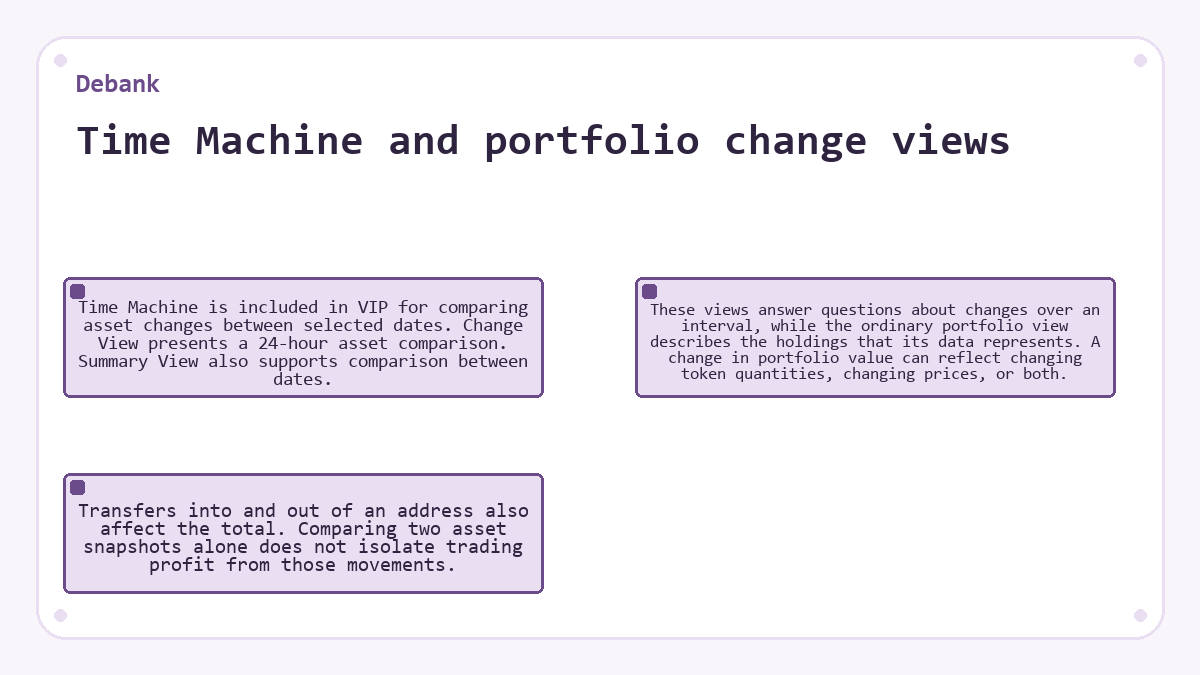
Time Machine is included in VIP for comparing asset changes between selected dates. Change View presents a 24-hour asset comparison. Summary View also supports comparison between dates. These views answer questions about changes over an interval, while the ordinary portfolio view describes the holdings that its data represents.
A change in portfolio value can reflect changing token quantities, changing prices, or both. Transfers into and out of an address also affect the total. Comparing two asset snapshots alone does not isolate trading profit from those movements.
Transaction analysis and profile options
Transaction History Analysis Mode adds summaries and record filtering. The history identifies activity, while dated portfolio views describe asset changes. Neither display alone supplies every detail needed for a complete accounting of returns.
VIP also lists custom profile pictures, cover pictures, and follow limits of up to 3 000 users and 300 official accounts. Cloud API access has its own credentials and usage accounting.
Web3 profiles connect portfolios and conversations
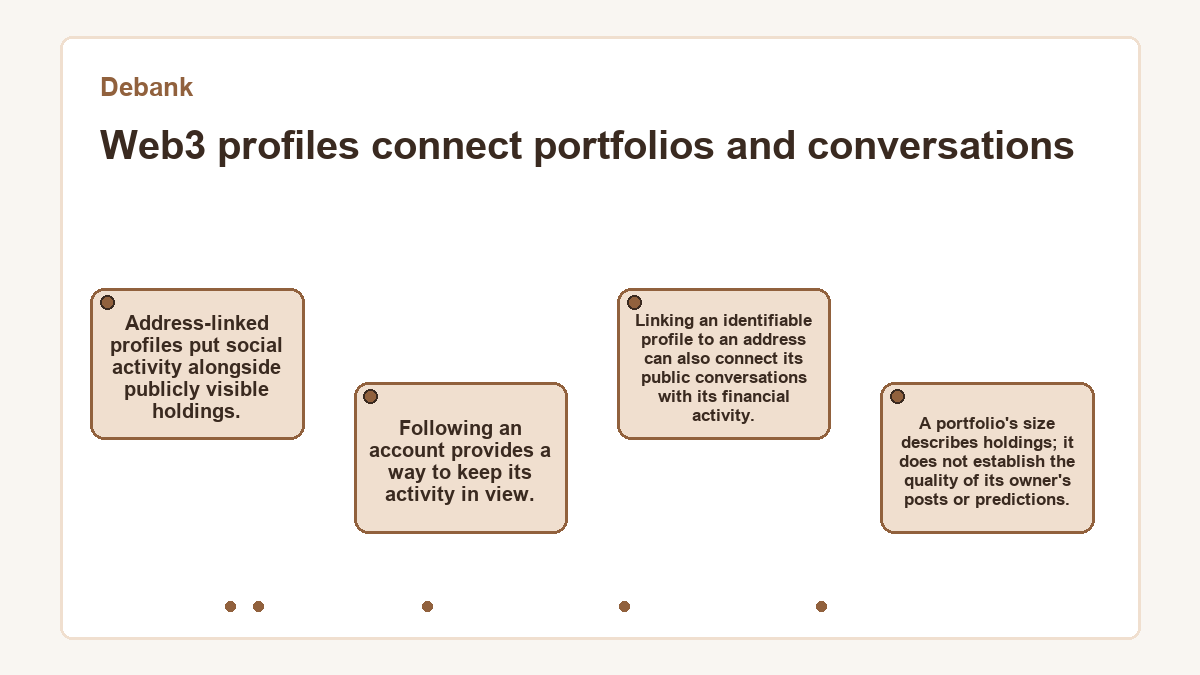
Address-linked profiles put social activity alongside publicly visible holdings. Following an account provides a way to keep its activity in view. Linking an identifiable profile to an address can also connect its public conversations with its financial activity. A portfolio's size describes holdings; it does not establish the quality of its owner's posts or predictions.
Stream, Hi, and paid consultations
Stream supports posts, comments, and sharing. Hi lets users set an attention price for messages from strangers. Debank also offers paid consultations with other users. Organizational accounts can publish updates and handle user inquiries. Their messaging rules distinguish contact with followers from contact with non-followers. An attention fee pays for attention under the relevant messaging arrangement; it does not buy proof that a statement is correct.
Credit, XP, and Web3 Badges
Credit measures user activity, authenticity, and value within the platform. XP records participation through activities such as referrals, Quests, and community interaction. Web3 Badges represent address-linked achievements. Quests and Lucky Draw add reward-oriented participation. Eligibility belongs to the particular activity or badge. Social metrics, achievements, and reward participation convey different information from the assets shown in a portfolio.
Portfolio data also powers applications and integrations
Debank Cloud provides an API for chain, token, and protocol portfolio data. An API lets software request structured records instead of reading a dashboard. API requests use access credentials, and usage units have a separate balance. Debank Connect supports application sign-in through OAuth 2.0 authorization. An authorized application can request profile information, on-chain portfolio data, and social information within its access scope.
Why can a reported portfolio differ from expected holdings?
A reported portfolio can differ because of integration coverage, failed chain requests, refresh timing, or the distinction between token quantities and their reported prices.
A supported chain does not establish support for every protocol position on that chain. Some interfaces can show a basic value while lacking richer position details. A failed chain request means that the displayed aggregate may not reflect all current holdings. The interface's update indicator and any request warning affect how the displayed balances should be read.
Refresh behavior belongs to the particular data service. An API endpoint's update policy does not establish a universal refresh interval for every dashboard component. Comparing records from different moments can create an apparent mismatch even when they describe the same address. Pricing and quantities also need separate interpretation: a recognized holding can lack usable valuation data.
An absent dashboard entry alone does not establish that an on-chain asset disappeared.
Match the portfolio question to the available view
- If account identity is uncertain, match the complete public address before interpreting the portfolio.
- If deposited assets seem missing from wallet holdings, examine the supported protocol position and its supplied-asset details.
- If gross holdings exceed the reported net position, subtract the position's reported debt from its asset value.
- If a chain request failed, treat the aggregate as potentially incomplete or outdated until that chain's data is available.
- If the question concerns asset changes between dates, VIP provides the historical comparison feature called Time Machine.
Debank: what people ask
Does disconnecting a wallet hide its public portfolio?
Disconnecting a wallet does not remove the address's public blockchain records. Address-based holdings remain discoverable through public data independently of the wallet connection. Profile settings and application permissions govern different aspects of account access, so disconnecting should not be treated as erasing an address's financial history.
What does TVF represent on a Debank profile?
TVF stands for Total Value of Followers and describes the portfolio value of the account's followers. It is separate from the profile address's own net worth. A large TVF does not mean that the profile owner controls the followers' assets, and it should not be read as that owner's available balance.
Are XP points a promise of a token airdrop?
XP points alone do not establish a promised token allocation or payment date. They record participation in the platform's XP activities. A particular reward or redemption arrangement has its own eligibility and terms; a points balance should not be interpreted as a fixed amount of claimable cryptocurrency.
How should a Web3 Badge affect trust in a profile?
A Web3 Badge indicates qualification for the particular achievement it describes. It does not establish that every statement made by the profile owner is accurate. Its eligibility conditions define the scope of the badge; those conditions do not transfer to unrelated financial claims or recommendations.
Is contacting an organizational account subject to an attention fee?
Messages that users send to organizational official accounts are free under the messaging rules for that route. An official account's messages to its followers are also free. To contact a non-follower, the official account pays the recipient's attention fee. The recipient receives it if they read the message within seven days; otherwise, the official account receives a full refund.
What happens if I decline a Debank Connect authorization request?
Declining a Debank Connect request stops that authorization flow. The application does not receive authorization through the refused request. Access scopes can cover profile information, on-chain portfolio data, and social information, so the requested scope matters when considering a later request. Refusal does not erase public blockchain data.
Why does the token-list API sometimes report a zero price?
A zero price in the token-list API means that price data is unavailable. It does not establish that the asset is worthless or change the recorded token amount. Software should preserve the distinction between an unpriced holding and a zero token balance when calculating or displaying portfolio values.
Do tokens with matching symbols represent the same asset?
Matching symbols do not establish that two tokens are the same asset. The chain and contract address identify a contract-based token, while native assets use their network-specific identifiers. Display names and symbols help with readability, but they should not replace those identifiers when matching holdings across wallet and portfolio records.